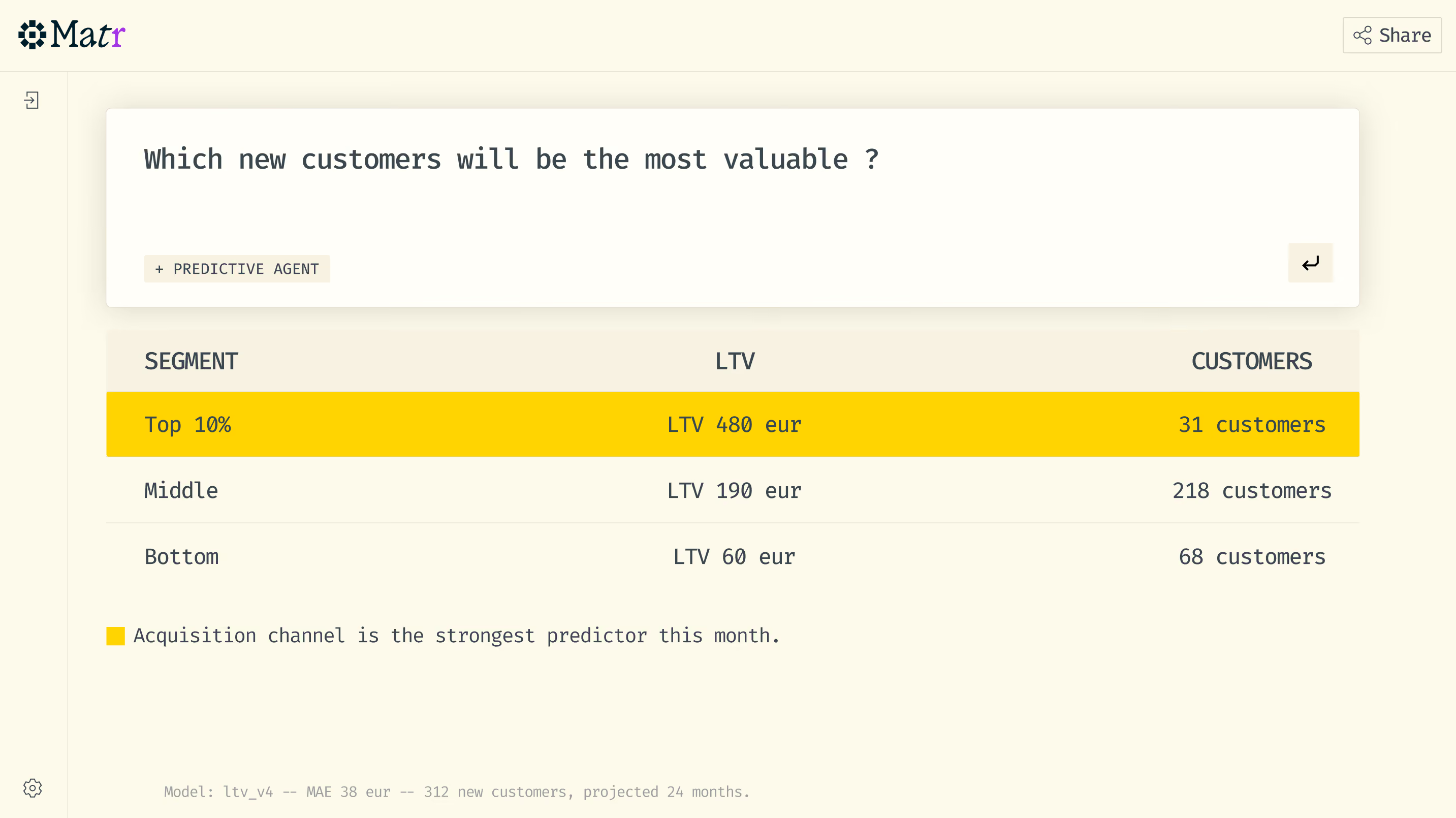
LTV is on every dashboard. It changes almost nothing.
A number everywhere
Your BI tool reports LTV. Your subscription platform shows customer value. Your finance team recomputes it every quarter. Most deliver a number you can't act on.
An average of the past
The LTV on your dashboard is a cohort average, built from what already happened. It tells you what last year's customers were worth, not what this one will be, or why.
Too late to matter
By the time the quarterly figure lands, the acquisition budget is spent and the high-value customer you could have protected has quietly churned.
Matr turns your data analyst into a data scientist. Ask a business question in natural language, Matr handles the feature selection, model training, validation, and deployment. Your analyst stays in control.


Detection
"Give me the 500 customers most at risk of churning in the next 30 days."
You get the list, ranked by probability, with the signals that drove each prediction (drop in usage frequency, unopened recent emails, unsubscribe page visits).
Understanding
"Why is the Premium segment churning faster this quarter?"
Matr analyzes, cross-references variables, returns the main factors. Not a spreadsheet. An explanation, structured, actionable.
Action
"Which at-risk customers are most likely to respond to a 15% retention offer?"
You get the sub-segment to activate first, with projected response rate. The campaign builds itself from there.
Measurement
"What was the impact of last month's campaign on actual churn for the targeted customers?"
The model returns the gap between predicted churn and observed churn, with interpretation. You know what worked. You iterate.
No more translating what you want into technical language. Your team asks questions the way they'd phrase them in a meeting.
Blissim cut churn by 20%
The Challenge
Blissim was losing €200K/month to churn. No data scientist on staff. No time to build a model from scratch.
The Solution
Matr deployed a churn prediction model on BigQuery in one day. The model scores every customer, identifies high-risk profiles, and feeds retention campaigns.
The Impact
- +20% customer retention
- +40K/month recovered revenue
- Model deployed and in production
Recommending the right product isn't enough on its own. The recommendation only matters if it reaches the right customer, at the right moment, with the right reason. All of these questions are handled by the same models, in the same platform, through conversation.
Use
Protect the high-value customers most at risk, first
Adapt what you suggest to customer value, not just behavior
Build value-based segments, not just behavioral ones
LTV isn't an end in itself. It's the lever that tells every other decision where to aim. One that Matr deploys consistently, with the same models, the same data, the same method.
another query tool.
Everyone
Natural language
Seconds
Unlimited
Built-in on every result
Automatic
One click
Save widget to dashboard
Yes
Natural language
Questions we hear most.
Every month you spend building ML in-house is a month your competitors spend shipping predictions.
Do I need a data scientist to use Matr?
No. That's the whole point. Your data analyst describes the business question in natural language — Matr handles the ML pipeline.
What types of models can I build?
Classification (churn, scoring, segmentation), regression (revenue forecast, demand planning), and time-series forecasting. Matr selects the best approach based on your data.
How accurate are the models?
It depends on your data quality, but Matr shows you accuracy metrics, baseline comparison, and confidence scores so you can make an informed decision. Typical results: 75-95% accuracy on well-structured data.
Where does my data stay?
In your warehouse. Matr connects to your Snowflake, BigQuery, or PostgreSQL. No data is moved or duplicated.
Can I integrate predictions into my existing tools?
Yes. Via REST API, direct warehouse write-back, or scheduled exports. Predictions flow into your CRM, ERP, spreadsheet — wherever your team works.
What happens if the model's performance degrades?
Matr monitors model drift continuously. When performance drops below threshold, it flags the issue and can trigger automatic retraining.
For more questions, feel free to contact us

