
Most models don't die at creation. They die afterwards.
Day one
A model is deployed. It works. Everyone moves on.
The drift
Three months later, a new product line appears. The model doesn't know it.
Six months later, customer behavior has shifted. The model still predicts the old world. A year later, business teams no longer trust it.
The silent death
Nobody killed the model. It faded out, slowly, with no alarm. Teams are back to deciding on instinct, without saying so.
That's the fate of most ML projects: not a failure at launch, an erosion afterwards.
The real value of a model isn't measured the day it's deployed. It's measured eighteen months later. Whether it's still used, still right, still trusted.
Matr takes care of the full lifecycle, from validation before deployment to continuous retraining. Not a part. The entire cycle.
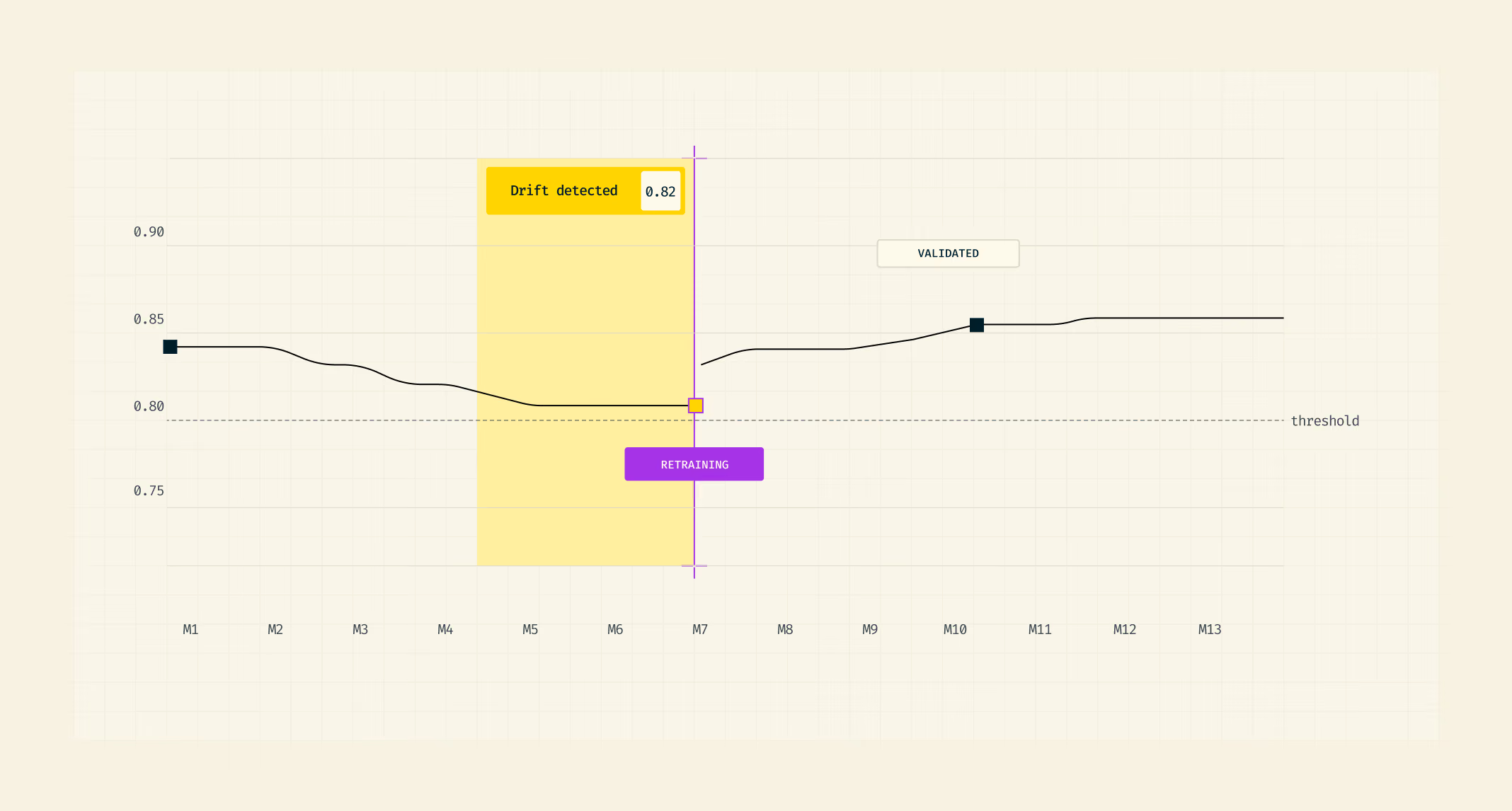
Every step is handled by Matr and visible to your teams. The model doesn't disappear into a black box after deployment. It stays under control, supervised, and improvable.
performance, robustness, bias.
A model doesn't go into production because it shows a good score. It goes into production because it has been validated on three dimensions:
Performance
Is the model accurate, not just on average, but on the segments that matter?
Robustness
Does it hold up against data slightly different from training? No overfitting, no hidden fragility.
Bias
Does it produce systematically unfavorable decisions for certain segments? Caught before deployment, not after the incident.
Concretely: predictions are queryable in plain language, the reasoning is returned with every answer, and teams can challenge the model instead of submitting to it. Explainability is put at the service of adoption, not just compliance.
Matr handles retraining, in automatic or semi-automatic mode depending on your desired level of control:
Automatic
The model retrains on a defined cadence or drift threshold, with no intervention.
For stable use cases where speed matters.
Semi-automatic
Matr prepares the retraining, your teams validate before production.
For sensitive use cases where control matters.
A model's value only exists where the decision is made.
Matr pushes predictions to where your teams already work: into your data warehouse, and into your business tools.
Use
Predictions are written to your tables, available to your full stack
Klaviyo, Braze, Iterable, Salesforce. Predictions feed campaigns directly
Your teams query the models in plain language, no export required
No multi-month integration project. The prediction arrives where the decision is made, in the format that makes it usable.
A model your teams don't use is a dead model. Even if it works perfectly.
Two ways to die
Technical: the model degrades, predictions drift and become wrong. Human, and far more common: it works fine, but teams don't trust it, don't understand it, and stop using it.
Two ways to survive
Monitoring: Matr tracks performance over time and flags when retraining is needed.
Explainability: every prediction shows its reasoning. When a team understands why the model recommends what it does, they keep using it.
Concretely: predictions are queryable in plain language, the reasoning is returned with every answer, and teams can challenge the model instead of submitting to it. Explainability is put at the service of adoption, not just compliance.
What stays with you.
Transparency on the division of responsibilities is itself a sign of seriousness. Here, without gray areas, who does what.
Matr
Your teams
Validation
Runs performance, robustness, bias detection
Validate business acceptance criteria
Deployment
Pushes predictions to warehouse and tools
Define destinations and triggers
Adoption
Provides explainability and conversational access
Use predictions in their decisions
Monitoring
Watches drift and new categories continuously
Receive alerts and arbitrate edge cases
Retraining
Prepares and runs (auto or semi-auto)
Validate in semi-automatic mode
Governance
Tracks and historizes everything
Retain oversight and final decision
Questions we hear most.
Every month you spend building ML in-house is a month your competitors spend shipping predictions.
Do I need a data scientist to use Matr?
No. That's the whole point. Your data analyst describes the business question in natural language — Matr handles the ML pipeline.
What types of models can I build?
Classification (churn, scoring, segmentation), regression (revenue forecast, demand planning), and time-series forecasting. Matr selects the best approach based on your data.
How accurate are the models?
It depends on your data quality, but Matr shows you accuracy metrics, baseline comparison, and confidence scores so you can make an informed decision. Typical results: 75-95% accuracy on well-structured data.
Where does my data stay?
In your warehouse. Matr connects to your Snowflake, BigQuery, or PostgreSQL. No data is moved or duplicated.
Can I integrate predictions into my existing tools?
Yes. Via REST API, direct warehouse write-back, or scheduled exports. Predictions flow into your CRM, ERP, spreadsheet — wherever your team works.
What happens if the model's performance degrades?
Matr monitors model drift continuously. When performance drops below threshold, it flags the issue and can trigger automatic retraining.
For more questions, feel free to contact us