
Recommendations are everywhere. Yet most are blind.
Noise everywhere
Your e-commerce platform has a recommendation widget. Your CRM has personalized blocks. Your email tool suggests products. They all promise relevance. Most deliver noise.
Rules in disguise
The widget shows last week's top sellers, dressed up as personalization. The "you might also like" block runs on a rule from 2022 nobody remembers.
A black box
When a recommendation works, you can't reproduce it. When one fails, you can't fix it. The logic is buried in a tool nobody can interrogate.
Ce que c'est
Suggest the right reactivation product to each at-risk customer
Adapt recommendation strategy to customer value, not just behavior
Build distinct recommendation logics per behavioral segment
Vos règles
Produits à pousser, à exclure, marges minimum. MatR les intègre pendant le cadrage.


Detection
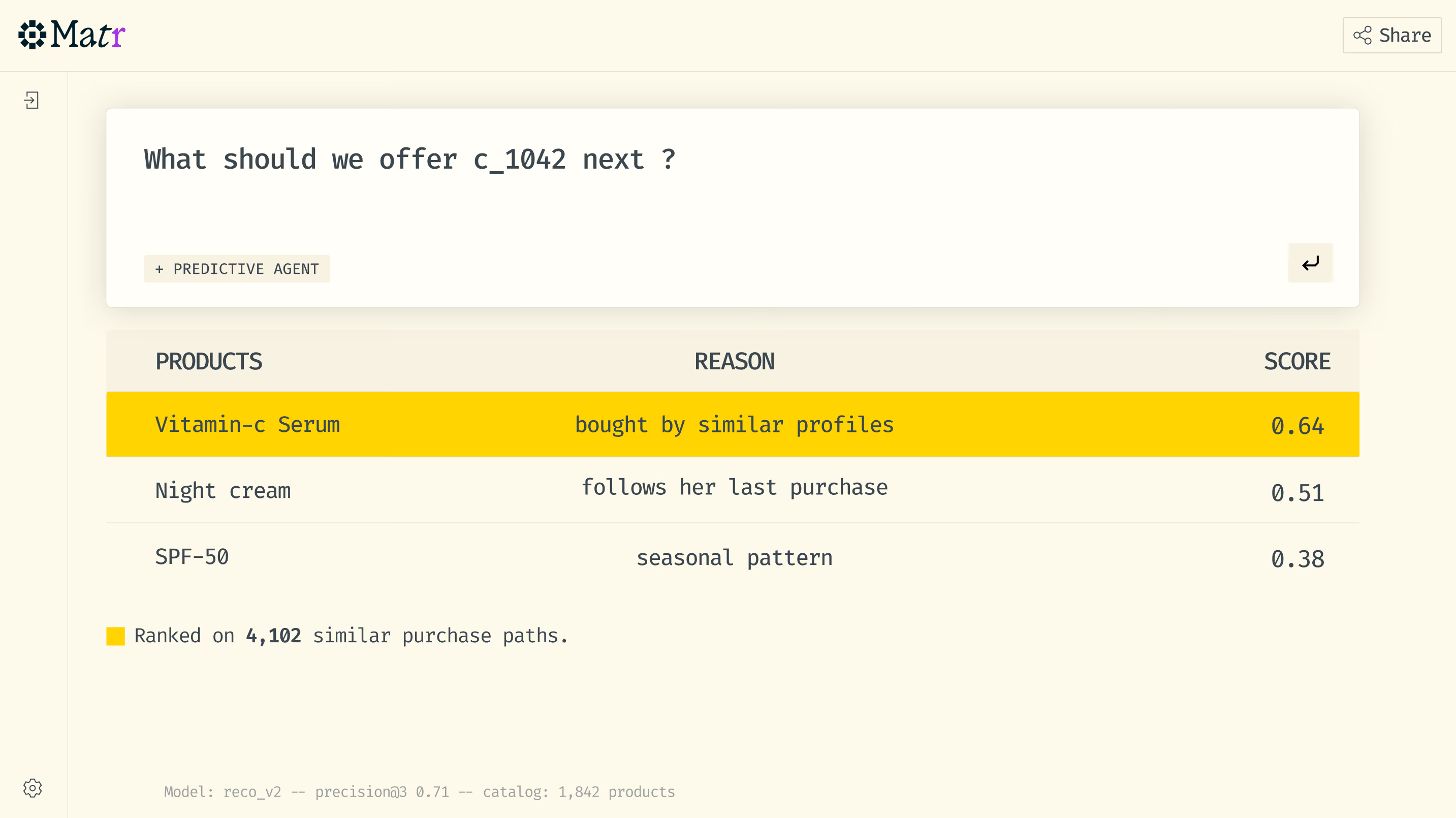
« Trois produits par client pour la campagne du mois. »
You get the list, ranked by probability, with the signals that drove each prediction (drop in usage frequency, unopened recent emails, unsubscribe page visits).
Understanding
"Why is the Premium segment churning faster this quarter?"
Matr analyzes, cross-references variables, returns the main factors. Not a spreadsheet. An explanation, structured, actionable.
Action
"Which at-risk customers are most likely to respond to a 15% retention offer?"
You get the sub-segment to activate first, with projected response rate. The campaign builds itself from there.
Measurement
"What was the impact of last month's campaign on actual churn for the targeted customers?"
The model returns the gap between predicted churn and observed churn, with interpretation. You know what worked. You iterate.
No more translating what you want into technical language. Your team asks questions the way they'd phrase them in a meeting.
another query tool.
Everyone
Natural language
Seconds
Recommandations par client.
Unlimited
Envoi vers l'emailing, le site ou le CRM.
Les questions qu'on nous pose.
Faut-il beaucoup de données ?
Il faut un historique d'achat par client. MatR évalue ce qui est possible pendant le cadrage.
Peut-on imposer des règles ?
Oui. Stock, marge, produits à pousser ou à exclure.
Ça marche en B2B ?
Oui. Les recommandations vont alors surtout aux commerciaux, dans le CRM.
Et pour un nouveau client ?
MatR s'appuie sur les clients qui lui ressemblent et sur les produits les plus achetés.