
LTV is on every dashboard. It changes almost nothing.
A number everywhere
Your BI tool reports LTV. Your subscription platform shows customer value. Your finance team recomputes it every quarter. Most deliver a number you can't act on.
An average of the past
The LTV on your dashboard is a cohort average, built from what already happened. It tells you what last year's customers were worth, not what this one will be, or why.
Too late to matter
By the time the quarterly figure lands, the acquisition budget is spent and the high-value customer you could have protected has quietly churned.
Ce que c'est
Protect the high-value customers most at risk, first
Adapt what you suggest to customer value, not just behavior
Build value-based segments, not just behavioral ones
Votre horizon
Valeur à un an, trois ans, sur toute la relation. MatR le fixe avec vous pendant le cadrage.


Detection
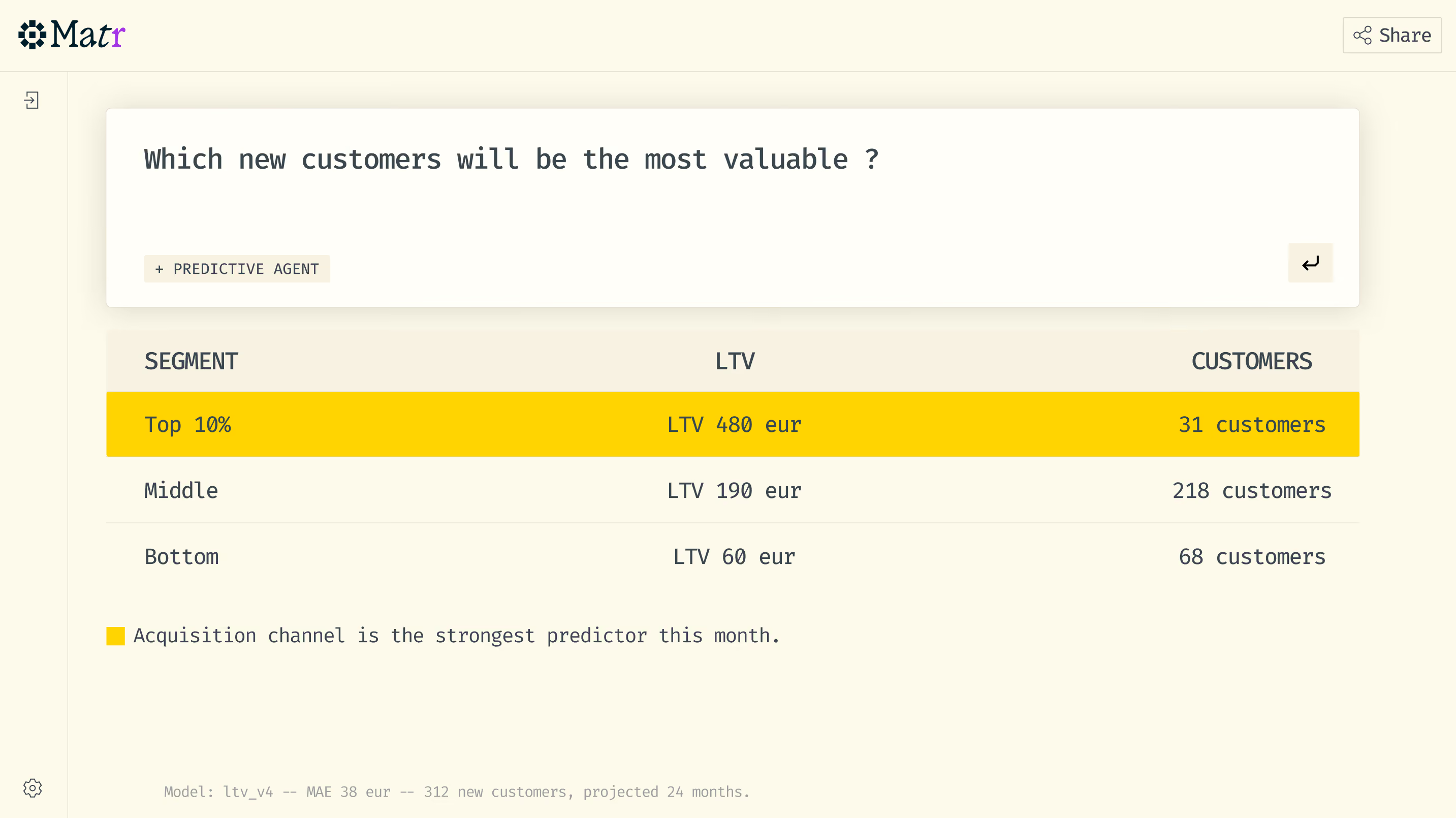
« Quelle est la valeur moyenne sur trois ans des clients venus par chaque canal ? »
You get the list, ranked by probability, with the signals that drove each prediction (drop in usage frequency, unopened recent emails, unsubscribe page visits).
Understanding
"Why is the Premium segment churning faster this quarter?"
Matr analyzes, cross-references variables, returns the main factors. Not a spreadsheet. An explanation, structured, actionable.
Action
"Which at-risk customers are most likely to respond to a 15% retention offer?"
You get the sub-segment to activate first, with projected response rate. The campaign builds itself from there.
Measurement
"What was the impact of last month's campaign on actual churn for the targeted customers?"
The model returns the gap between predicted churn and observed churn, with interpretation. You know what worked. You iterate.
another query tool.
Everyone
Natural language
Seconds
Valeur client passée et prédite.
Unlimited
Envoi vers le CRM et l'outil marketing.
Les questions qu'on nous pose.
Faut-il un data scientist ?
Non. MatR construit et met à jour le calcul. Vous posez la question en français.
Valeur en chiffre d'affaires ou en marge ?
Les deux, si vos marges sont disponibles.
Et pour un nouveau client sans historique ?
MatR estime sa valeur à partir des clients qui lui ressemblent, et l'affine au fil des achats.
Combien de temps pour avoir les premières valeurs ?
Quelques semaines après le cadrage, selon vos sources.